

Comprehensive Research Report: The Cloud Computing Special Economic Zone and Saudi Arabia’s SEZ Network (2025–2026)
The establishment of Special Economic Zones (SEZs) in the Kingdom of Saudi Arabia represents a fundamental pillar of the National Investment Strategy under Vision 2030. These zones are designed to transform the Kingdom into a global hub for manufacturing, logistics, and advanced technology. In January 2026, the Saudi Cabinet approved the final regulatory frameworks for four new special economic zones, which are set to enter full operational force in April 2026, providing a clear legal and financial roadmap for strategic growth.
The Cloud Computing Special Economic Zone (Riyadh)
The Cloud Computing Special Economic Zone is a unique "virtual" model located at the King Abdulaziz City for Science and Technology (KACST) in Riyadh. It aims to attract 13 billion USD in investments in data and AI sectors by 2030.
1. Virtual Operational Model and Geographic Flexibility
Unlike traditional, geographically bounded zones, the Cloud SEZ features a flexible "virtual" module. This allows Cloud Service Providers (CSPs) to build and operate data centers from anywhere within the Kingdom of Saudi Arabia while still enjoying the zone’s full fiscal and regulatory incentives. The zone serves priority sectors including:
Digital Healthcare: Supporting massive medical data systems.
Smart Mobility: For future transportation technologies.
Industry X: Advancing the digitalization of manufacturing.
3
2. Financial Incentives and Tax Benefits for 2026
The Cloud SEZ provides a package of competitive incentives designed to position Saudi Arabia as a regional "Silicon Valley":
Corporate Income Tax (CIT): A reduced rate of 5% for up to 20 years, compared to the 20% standard rate in the base economy.
4 Withholding Tax (WHT): A permanent 0% rate on the repatriation of profits from the SEZ to foreign countries.
1 Value Added Tax (VAT): 0% VAT on all goods exchanged within the zone and between other Saudi SEZs.
1 Customs Duties: Deferral or 0% duties on capital equipment and technical inputs entering the zone.
Operational Costs: Highly competitive utility rates, with electricity provided at approximately 0.05 USD/kWh.
1 Labor Support: Exemption from the "Expat Levy" for employees and their families within the zone, coupled with flexible regulations for attracting foreign talent during the first five years.
4
Saudi Arabia’s Network of Five Special Economic Zones
In addition to the Cloud Computing zone, the Kingdom hosts four other SEZs, each targeting strategic sectors to enhance company formation in Saudi Arabia
King Abdullah Economic City (KAEC) SEZ: Located in Rabigh, focusing on advanced manufacturing, automotive assembly, and logistics, leveraging the King Abdullah Port.
Jazan SEZ: A gateway for trade with African markets, focusing on food processing, mining, and downstream manufacturing.
Ras Al-Khair SEZ: A global center for maritime industries, shipbuilding, and the maintenance of offshore drilling rigs.
Special Integrated Logistics Zone (SILZ): Located at King Salman International Airport in Riyadh, offering a 50-year tax holiday for supply chain and warehousing services.
4
Legislative Framework and Regulatory Compliance (2025–2026)
The ecosystem for business setup in Saudi Arabia underwent a historic shift in February 2025 with the implementation of the New Investment Law.
Transition to the Investment Registration Certificate (IRC)
The old "MISA license" or "Sagia license" system has been replaced by the Investment Registration Certificate (IRC).
The Role of the CST and Cybersecurity Standards
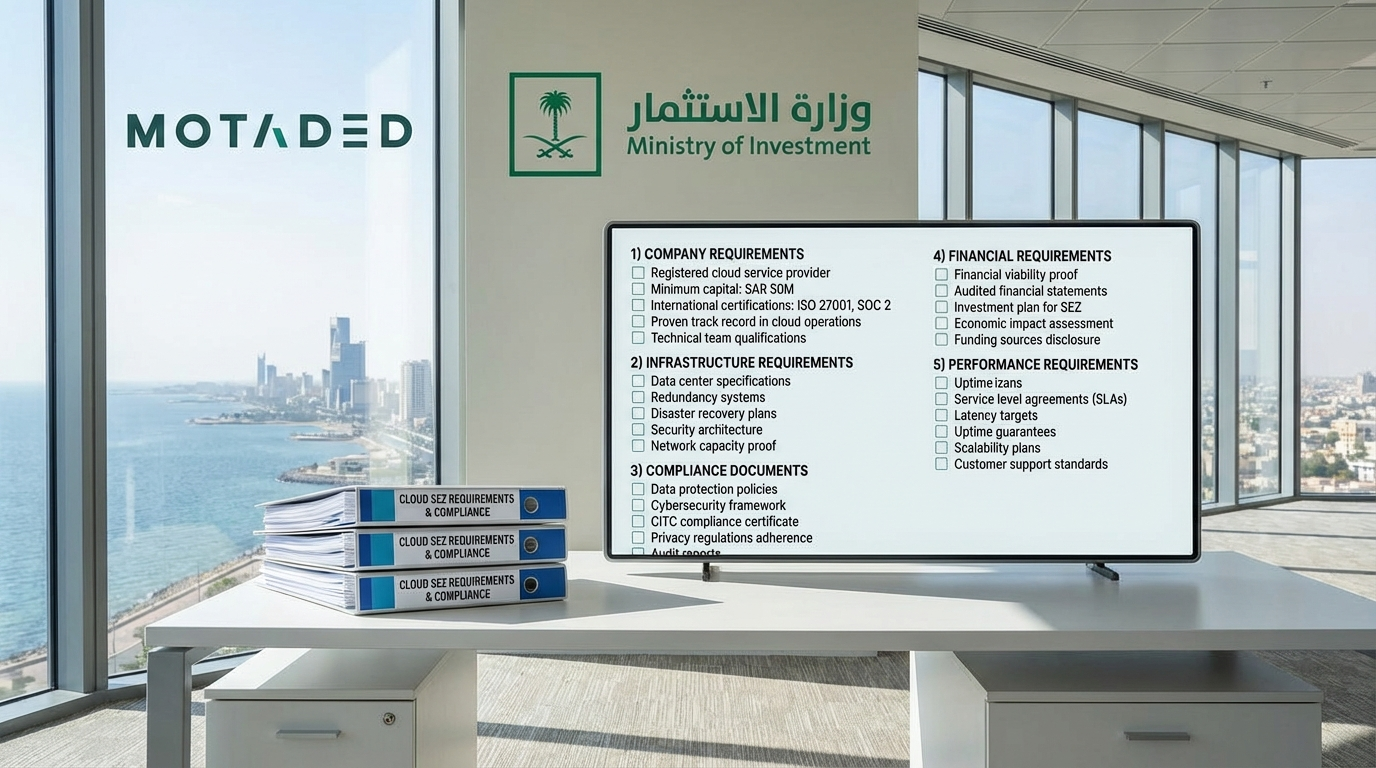
The Communications, Space and Technology Commission (CST) supervises the registration of cloud providers within four categories (Qualification, A, B, and C) based on data sensitivity. Applicants must comply with the National Cybersecurity Authority (NCA) controls, specifically the Essential Cybersecurity Controls (ECC) and the Cloud Cybersecurity Controls (CCC).
Frequently Asked Questions (FAQ) for SEZ Investors
| Question | Answer |
|---|---|
| Can foreigners own 100% of a company in an SEZ? | Yes, all Saudi SEZs allow 100% foreign ownership with full rights to repatriate profits. |
| What is the minimum capital for the Cloud SEZ? | There is no rigid minimum capital for this sector; MISA and CST evaluate the business model and innovation rather than just the balance sheet. |
| How is Saudization (Nitaqat) handled in these zones? | SEZs utilize tailored Saudization frameworks that reflect the technical nature of the activities, often including long-term exemptions (up to 10 years) to help attract global talent. |
| Does SEZ registration replace the Commercial Register (CR)? | No, after obtaining the IRC from MISA, the entity must still complete company registration in Saudi Arabia and obtain a Saudi Arabia commercial register through the Saudi Business Center. |
| What are the E-invoicing (ZATCA) deadlines in 2026? | Companies must comply with Phase 2 (Integration): Wave 23 (turnover > 750k SAR) by March 31, 2026, and Wave 24 (turnover > 375k SAR) by June 30, 2026. |
Conclusion and Strategic Outlook
The Saudi SEZs, particularly the Cloud Computing zone, offer an ideal environment for tech firms targeting a market estimated at 81 billion SAR.